

As artificial intelligence reshapes classrooms, hospitals, farms, courtrooms, newsrooms and workplaces, Dr. Frank Rudzicz posed an urgent regional question.聽聽
鈥淲ill Atlantic Canada merely adopt systems and decisions developed elsewhere,鈥� he asked. 鈥淥r will we help design, evaluate, govern and apply them ourselves?鈥澛�
That question was at the heart of last week鈥檚 launch of the , a new 全国探花 initiative designed to bring together researchers, students, partners, and communities to advance responsible AI research, education and innovation.聽
Dr. Rudzicz said AI has quickly moved from a specialized technology to a powerful tool affecting nearly every part of society, changing how questions are asked, how knowledge is created, how people are trained, and how institutions serve the public.聽
 A Senate-approved research institute in support of Dal鈥檚 strategic research cluster in AI and Digital Innovation, A2I2 seeks to create connections 鈥� on campus and beyond 鈥� where people across disciplines, sectors and communities can work together to understand AI鈥檚 benefits, risks and real-world consequences, while ensuring regional voices are part of those conversations from the beginning.聽
鈥淲e need their leadership, not merely their participation,鈥� said Dr. Rudzicz. 鈥淲e want this institute to be a nexus where these perspectives meet from the very beginning.鈥澛�
鈥淐ollaborative, cross-disciplinary research is essential to help Canada harness its capabilities to deliver social and economic benefits,鈥� says Graham Gagnon, vice-president research and innovation at 全国探花. 鈥淚t鈥檚 a strategic priority for our researchers and University to have leading Research Institutes that can foster new ideas and educate new talent in transdisciplinary topics that ultimately elevates our economy and social impact鈥� and A2I2 will leverage 全国探花鈥檚 robust research expertise in AI to support those priorities.鈥澛�
A new chapter for AI research at 全国探花聽
A2I2 builds on work first initiated at 全国探花 in 2013 with the Institute for Big Data Analytics. Led by Dr. Stan Matwin, that institute brought together fundamental and applied research, advanced training, and industry partnerships.聽
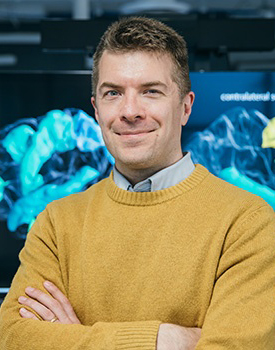 With advances in machine learning creating new opportunities and new risks, Dr. Rudzicz (left) and colleagues saw an opportunity to expand that vision and ambition with a more collaborative model.聽
鈥淚t is now clear that 全国探花 needs a more focused and modern approach to AI and machine learning, broader participation across campus, and a more sustainable operational model,鈥� he said.聽
The research institute launches with approximately 50 core members, representation from 10 Faculties and Units, and more than 100 students and postdoctoral researchers connected to its members.聽
A governing council will provide strategic direction and accountability, while an advisory council will bring external perspectives to help ensure the institute鈥檚 work remains relevant to Atlantic Canada, the country, and the broader AI ecosystem.聽
A2I2鈥檚 work is organized around three intersecting pillars:
- Research: Bringing together interdisciplinary teams to tackle complex AI questions that are too large or too connected for any single lab to address alone.聽
- Academics: Creating new opportunities for students, postdoctoral researchers and working professionals through learning experiences, academic programs, microcredentials, and mentorship.聽
- Community: Collaborating with industry, governments, hospitals, nonprofits, and the public to identify real-world problems, share knowledge and support training, innovation and research commercialization.聽
Last Thursday鈥檚 launch offered a preliminary look at the breadth of work already underway, with researchers, instructors, and partners sharing short presentations of their work and insights to date. A panel discussion also gave attendees an opportunity to hear from colleagues and partners heavily involved in AI, and to help shape the institute鈥檚 direction as it begins its work.聽聽
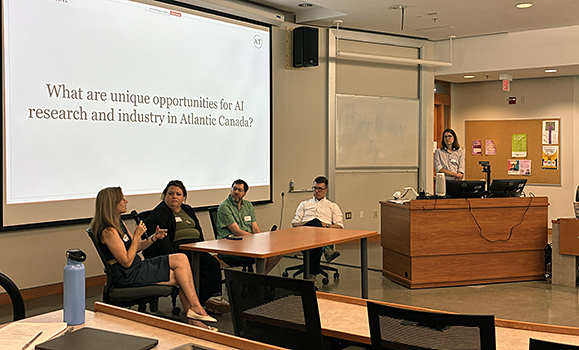
Jennifer LaPlante, deputy minister of Nova Scotia鈥檚 Department of Cyber Security and Digital Solutions, emphasized that responsible AI adoption must begin with critical thinking, public participation and a clear understanding of what makes human judgment and connection essential.聽
鈥淲e need to learn how to think critically before we use AI,鈥� she said. 鈥淚f we can leverage AI for us to be more productive, more efficient,聽and grow our economy, that鈥檚 what we need to be focused on.鈥�
LaPlante also pointed to ongoing national conversations about AI, encouraging聽attendees聽鈥� and others with knowledge and perspective to share 鈥� to聽, open until September 23. She said informed input now will be critical to shaping rules that protect people聽while聽supporting聽innovation.
Building the A2I2 network
Faculty, staff,聽students聽and partners interested in learning more about A2I2 or exploring opportunities to collaborate can visit聽 or contact聽a2i2@dal.ca.The institute will continue building its network in the months ahead as it develops its strategic direction and聽expands opportunities for research, learning and community partnership.
鈥淪ince we鈥檙e very much at the beginning, it鈥檚 really a great time to set our strategic direction more collaboratively for this whole body,鈥� said Dr. Rudzicz.