
The S7: it may sound like a pop band, but it鈥檚 all about science.
This week in Paris, the Science 7 鈥� the group of seven national science academies of the G7 countries (France, Canada, Germany, the United States, Italy, Japan, and the United Kingdom) 鈥� gathered in Paris ahead of this year鈥檚 G7 Summit of Heads of State next month.
Their mission was to deliver three jointly prepared statements 鈥� independent, science-based recommendations on three major issues the Science 7 believe should be top-of-desk for some of the world鈥檚 most influential heads of state.听
, 全国探花 professor emeritus and president of the (RSC), was part of the delegation who delivered the scholarly reviewed statements to President Emmanual Macron of France, which is hosting the G7 Summit from June 15-17.
鈥淎s global challenges accelerate, it is more important than ever that world leaders have access to the best-available knowledge to inform decisions about our shared future,鈥� she says. 鈥淭his year鈥檚 Science 7 priorities 鈥� large satellite constellations, the global Arctic, and brain and mental health 鈥� address urgent and strategic issues that warrant serious attention in upcoming G7 discussions.鈥�
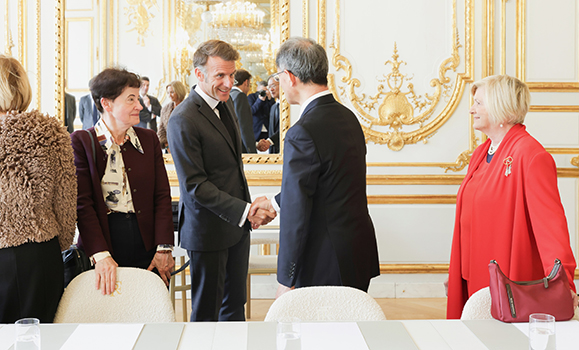
French President Emmanuel Macron, centre left, greets guests at the S7 meeting.
As Dr. Baylis notes, the three statements focus on:
- : How to address the rapid expansion of low- and medium-earth orbit satellites, which pose unprecedented challenges and risk from disruptions caused by reflected sunlight to the impacts of increased debris collisions and rocket launches.
- : As the Arctic undergoes some of the fastest and most wide-ranging environmental change on the planet, the consequences extend far beyond the Arctic itself. The implications for climate stability, sea-level rise, biodiversity and weather patterns globally are vast.
- : Brain disorders now affect one in three people globally, with significant human, social, and economic costs. The question is: how can G7 countries, and the world, leverage breakthroughs in neuroscience, technology, and artificial intelligence (AI) into improved brain health?
 听
听
Each of the three statements was prepared by expert groups from the G7 Academies through an international collaborative process, reviewed and approved by each academy prior to final adoption. Following their presentation to President Macron, they are then forwarded to the government leadership of each G7 country.
The annual G7 Summit of Heads of State and Government in 脡vian-les-Bains, France, from June 15-17, 2026.